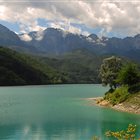
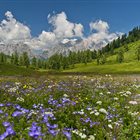
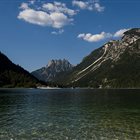
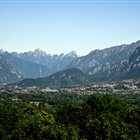
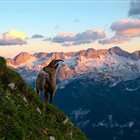
The proposal, sunny and not tiring, is really worth a thought because you will find yourself walking through a very isolated, wild, solitary valley. Another of the most unspoiled corners of the area, where it will seem as if you are in a primordial world where no one has ever passed except friendly creatures of fur and feather. You will also have the chance to experience the pleasure of adventure for a while because there are neither trails nor waymarks. From the pass, you get beautiful views over the Sappada valley and the mountains surrounding it to the north, as well as those of the Comelico valley, but especially over the Pesarina valley, the Carnic Prealps, and the distant Julian Alps. There is also a pleasant surprise: in the upper part of the valley, you come across a horizontal fissure in the ground, a kind of small underground cave that permanently holds some snow inside — essentially a 'micro-glacier'!
Author: © Giovanni Borella
C.A.I. Sappada/Plodn
Interreg V Italy-Austria - CLLD Dolomiti Live. Project “Safe Mountain – Mountain Adventure” ITAT 4019 CUP B43J16000270004
Derived from the technical difficulty and the stamina requirements.
Difficulty: E/EE
Hours from the dairy hut: ascent 1:00-1:15, descent 0:45-1:00, total 1:45-2:15
WAYMARKS: trail track
DIFFICULTY SCALE
The technical sheet of each itinerary includes the abbreviations commonly used in mountain guides (T- E - EE- EEA - A). Some itineraries may have a double abbreviation (e.g., T/E or E/EE) as they present characteristics of both categories
T (touristic) indicates routes that are almost always short and easy, running on forest roads and/or well-marked or clearly visible trails that do not require special training
E (hiking) indicates routes, sometimes quite long, that run on mule tracks and/or trails often above 2000 meters, visible but not always with waymark signs. They have no significant difficulty but may occasionally present some slightly exposed or awkward sections or passages. Adequate equipment, a minimum of experience, and training are required
EE (for expert hikers) indicates routes generally above 2000 meters, which may run on tricky terrain and/or in rugged areas, often characterized by exposed and/or equipped passages or sections, sometimes on rock with 1st grade difficulty. They require experience, sure-footedness, sense of direction, good equipment, and physical-psychological preparation.
EEA (for expert hikers with equipment) indicates paths equipped with metal cables, steps, ladders. Exposure is almost always constant. Experience, training, and appropriate equipment including helmet and via ferrata set are mandatory. Gloves are useful.
A (for climbers) indicates rock routes leading to peaks with low climbing difficulties (1st/2nd grade). They require technical skills, good experience, physical preparation, suitable equipment (helmet, some slings, always useful also a rope about 20-30 meters long)
WARNINGS
© Extracted from the Guide "Sappada, from trails to summits" by Giovanni Borella, published by CO.EL. publishing house.
Giovanni Borella Born in Belluno, where he lived until adolescence. He then moved to Padua, where he still lives, attending the local University and earning a degree in Ancient Literature, which led him to teach for several decades. Hiker first, then climber, he made numerous ascents in the most well-known Dolomite groups and especially on the mountains of Sappada, which he frequents for many years in summer and winter and where he also opened new routes and repeated others solo. He has published three guides: "On the trails of the sun" ed. Mediterranee 1995 as co-author, "Sappada, from trails to summits" Co.El. publisher 2002, "Dolomites of Comelico" Linteditoriale 2010.
Localization
Derived from the technical difficulty and the stamina requirements.